
A business continuity plan is not a document you write once and file away. It is a living process — the foundation of your resilience as an organisation.
Building a Business Continuity Plan (BCP) for your SME in Dublin or Ireland requires understanding the key principles behind it. Whether you are dealing with a cyberattack, a flood, a power outage, or a supplier failure, a solid BCP tells your team exactly what to do, who to call, and how to keep the business running.
1. What is a Business Continuity Plan?
A BCP (Business Continuity Plan) maintains a level of operational availability — even if degraded — during an incident or crisis. It brings together the means, equipment, and procedures needed to prevent a complete halt to business activity (for companies, local authorities, hospitals, etc.).
It tells staff what to do, who to notify, and what actions to implement — so the organisation can react quickly and confidently when disruption strikes.
This document must be formalised and regularly updated to account for all risks that may arise during operations and the best way to contain them.
2 & 3. Two Types of Analysis
For effective BCP implementation, you must continuously monitor potential risks and conduct two types of analysis.
Risk Analysis
Risk analysis identifies all threats that could affect the organisation. Threats may be human (accidental or deliberate), natural, or technical — and can originate internally or externally.
Impact Analysis
Impact analysis evaluates the likelihood of each risk occurring and determines from which point its impact would threaten the survival of the business.
In addition, conduct a vulnerability analysis of your organisation. This highlights strengths, weaknesses, and critical points that must be protected.
4. Classifying Scenarios with a Risk Matrix
Once your analyses are complete, classify risks in a matrix. The table below allows you to rank risks by impact, probability, and severity:
- G = 1: low probability, low impact — monitor
- G = 2: moderate probability or impact — plan a basic response
- G = 3: significant probability and impact — prioritise in your BCP
- G = 4: high probability, critical impact — essential to business survival
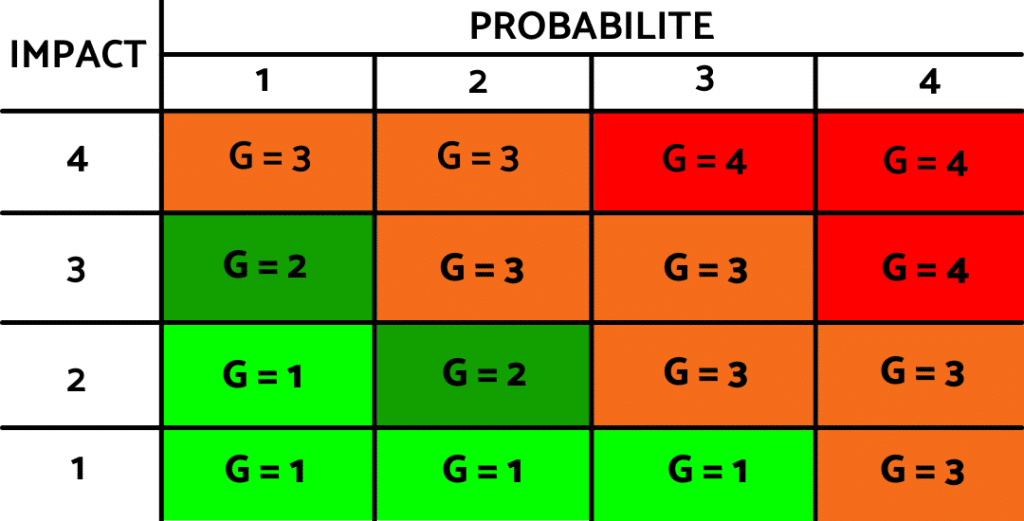
Once classified, you can define the actions and behaviours to implement for each scenario. Communicate these scenarios to all staff and practise them where possible.
5. Potential Consequences of Poor BCP
- Loss of revenue during downtime
- Damage to company reputation and client trust
- Failure to meet legal or contractual obligations (including GDPR in Ireland)
- Negative perception from suppliers, clients, partners, and employees
6. Four Criteria for an Effective BCP (DRII)
According to the Disaster Recovery Institute International (DRII), an effective BCP must meet four criteria:
- Resume without notice: continue activity transparently, without users noticing disruption
- Data stored off-site: store data outside the premises to always have access in the worst-case scenario (disaster) — essential for any DRP/BCP strategy
- Within recovery time objective: set a recovery time objective (RTO) and implement additional solutions if it is exceeded
- Without key personnel: the continuity plan must not depend on one individual — it must be launchable by anyone
7. Key Questions to Ask Before Writing Your BCP
- What budget can you allocate — and what is the economic impact of one hour of IT downtime?
- Is a complete IT shutdown for one hour acceptable to your business?
- Which tools are essential to operations, and what are the consequences of each going offline?
8. A BCP Is Never Final
A business continuity plan is never finished. It must be continuously improved, revisited, and updated to account for new risks, new tools, and lessons learned from incidents and exercises.
However, when properly maintained, it will allow your organisation to react correctly when one or more of your planned scenarios occurs — and it will reassure both your staff and your clients that you are prepared.
Depending on your sector, your BCP may also need to integrate: quality assurance, premises security plans, staff protection plans, alert and rescue procedures, and legal/insurance risk management.
Let’s discuss your situation.
30 minutes, no obligation.
Let’s take a look together at what it would take to ease your IT workload. No sales pitch. Just an honest assessment of the situation.
Your IT architect. Your trusted partner.