
When disaster strikes your IT systems — fire, flood, ransomware, hardware failure — two plans come into play: the Disaster Recovery Plan (DRP) and the Business Continuity Plan (BCP). Understanding the difference between DRP and BCP is essential for every SME in Dublin and Ireland. One gets you back up after a crash. The other keeps you running during a crisis.

DRP — Disaster Recovery Plan
The DRP (Disaster Recovery Plan) applies when a major disaster strikes your IT system: fire, flood, ransomware attack, hardware destruction.
It covers every type of incident and defines what to put in place and how to restart business operations. The goal is to establish a recovery scenario so the company can always restart, even after a major event.
In Ireland, having a DRP is also a requirement under NIS2 and GDPR for businesses handling sensitive data.
BCP — Business Continuity Plan
The BCP (Business Continuity Plan) applies when an IT element becomes unavailable — but is not completely destroyed. The goal is to keep operating despite partial unavailability.
It identifies potential threats to the IT system, their financial, legal, and human impacts, and determines the maximum acceptable downtime and the maximum time after which an IT resource must be restarted.
The aim: minimise downtime as much as possible, keeping the business running continuously.
RTO and RPO: The Two Key Metrics
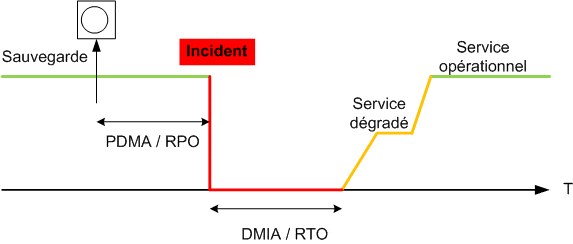
RPO — Recovery Point Objective
RPO defines the maximum acceptable data loss. It answers the question: “How much data can we afford to lose?” — measured in time (e.g., last 4 hours of data).
The lower your RPO, the more frequent your backups must be.
RTO — Recovery Time Objective
RTO defines the maximum time allowed to restore systems after an incident. It answers: “How long can the business tolerate downtime?”
Many organisations define tiered recovery solutions based on their RTO targets.
40%
of system failures are caused by human error
85%
of IT breaches originate from inside the organisation
80%
of businesses that lose their data go bankrupt within 12 months
DRP or BCP: Which Should You Prioritise?
For most SMEs in Dublin and Ireland, the answer is: both — but implemented in order of risk severity. Here is a practical framework:
- Start with a DRP if you have no off-site backup or recovery procedure — data loss after a disaster is existential
- Add a BCP to keep operations running during partial outages — minimise revenue loss during incidents
- Define your RTO and RPO — these metrics drive every architectural decision about backups and redundancy
- Store backups off-site or in the cloud — a backup stored on-site is destroyed in the same fire as your servers
Let’s discuss your situation.
30 minutes, no obligation.
Let’s take a look together at what it would take to ease your IT workload. No sales pitch. Just an honest assessment of the situation.
Your IT architect. Your trusted partner.